
In a Room and a Half
A Meditation on an Essay by Joseph Brodsky

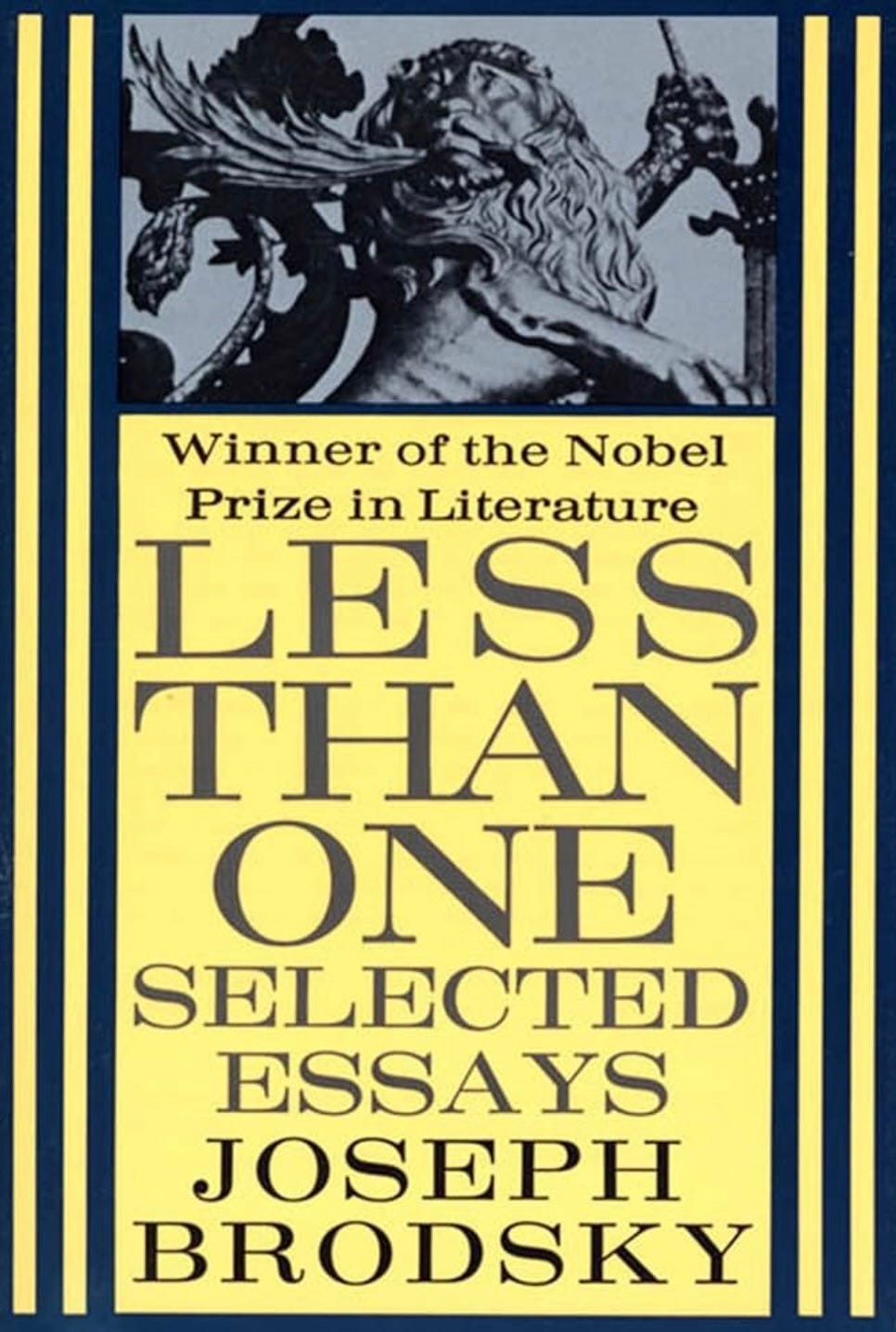
“A normal man doesn’t expect anything to continue; he expects no continuity even for himself or his works.”–Joseph Brodsky, “In a Room and a Half”
During the tyrannical worldwide lockdown in the spring of 2020, I found myself, when my girlfriend wasn’t with me, more alone than I’d ever been. Which is saying a lot because I’ve lived on my own for more than 30 years and I socialize very little. One day, I found myself reading—or rereading—Joseph Brodsky’s exceptional collection of essays, Less Than One. I was particularly drawn to one essay in that book, “In a Room and a Half.”
In that essay, Brodsky recalls his childhood home in Leningrad (now and again St. Petersburg). The teenage Brodsky had transformed the one large room his small family—Brodsky and his parents—had been allotted by Soviet authorities into two (or rather into one and a half to avoid breaking the Soviet rule of only one room per family) by utilizing two large armoires, two large book cases, and a desk to cordon off a space between himself and his parents, leaving him with, as he writes, “the best ten square meters I have ever known.” He called it his lebensraum, which is German for “living space.”
I’d wandered past my many shelves containing my many books looking for something that captured the despotic ruse we had been subjected to during that nearly infinite “two weeks to stop the spread” charade with its mandates and restrictions raining down upon us like nails. I instinctively turned to writers from that colossal and murderous failure of a human experiment we called the Soviet Union and the Eastern Bloc. Brodsky’s book caught my eye, and I reached up with the mysterious, calm precision of a sleepwalker—that’s what I often felt like back then—blew off the dust that had accumulated on it and laid it on the table next to my reading chair.
Less Than One was first published in 1986, the same year I’d found myself in China, another brutal totalitarian country—as if a totalitarian country can be anything other than brutal—south of Brodsky’s Soviet Union. By then he was no longer in the Soviet Union; he’d been expelled in 1972, after which he settled in the United States. At first, he was not happy about it. You’d think being kicked out of a country that seldom parted its iron curtain to let anyone of their enslaved captives leave on their own accord would be a Godsend. But for Brodsky it was nothing short of being thrown out on his ears and having the door slammed shut behind him, cut off from his family and friends. He writes: “For us, an apartment is for life, the town is for life, the country is for life. The notions of permanence are therefore stronger; the sense of loss as well.”
I’d bought the book soon after I’d returned from a year and half of teaching in China in the summer of 1987, the same year Brodsky won the Nobel Prize for Literature, the fifth Russian-born writer to do so. Maybe I was looking for someone to commiserate with regarding my experiences living in a communist country that had modeled its totalitarian regime after the country where he’d lived. But why pull it off the shelf now, if only by presentiment? For the same reason, most likely. Only it wasn’t my time in China that I was reeling from now. It was my experience of authoritarianism here in my own country. We had been suddenly trapped in lockdowns and forbidden to leave our own country just like Brodsky and other Soviet citizens could not voluntarily leave theirs in that other time and place.
I was feeling despair, too, about the undermining and demoralizing COVID-19 madness into which our world had plunged. At the beginning of it all, I smelled a rat but I also felt it was not my time to speak out. I felt that I needed to assess what was really happening as every day brought more warnings, fear, nonsense, and restrictions. As the Nobel Prize-winning French writer, Albert Camus, in the midst of violent antigovernment protests in his native Algeria, once wrote: “To understand this world, one must sometimes turn away from it; to serve men better, one must briefly hold them at a distance.”
***
In a manner of speaking, I barricaded myself inside my house to do this, much like Brodsky had barricaded himself behind all of that furniture to create a room of his own; to give himself privacy for his own process of self-discovery and to nurture his budding literary talent. To be sure, I had in my own small house a lot more private space than Brodsky had in that communal apartment. Yet, I felt that the despotic lies our government was spewing about COVID-19 and all of the enthusiastic if not insane swarms of compliant acolytes—I live in a blue area in a blue state—were closing in around me. And it was simply because I was beginning to figure out that what we were being told, and which most of those around me—and much of the rest of the world—believed was not truly what was happening.
I felt morally paralyzed. Creatively paralyzed, too. In what was for me a rare period of disorientation, I didn’t know what to do with myself, which way to turn. I felt as if I’d been dropped into a strange, new world without a map or a GPS device. I knew early on that the enemy was not a deadly virus most of humanity had so suddenly become afraid of. It was something far more insidious—and dare I say evil—than that, a kind of tactical maneuver driven by media and governmental fear mongering. Whether this so-called virus was concocted in a lab or had naturally arisen from some bat in the hinterlands of China—which quickly became, and remains, a big bone of contention to this day—was not as concerning to me as the overarching plot I saw unfolding to trick humanity into fearful acquiescence to do whatever we were being told to do.
At first, the way I saw it, the goal was control. After all, that’s what dictatorships want more than anything. It is the golden ring they are always committed to snatching. Having lived and worked in China and having visited the Soviet Union twice (the first time on the Trans-Siberian Railroad from China) before it collapsed like the rotting house of cards it truly was—I know this in my bones. No one will ever be able to tell me otherwise. Ultimately, what I and many others I was following online soon figured out—and this was a chilling leap for me—was that the goal was to get the world’s population injected with a bioweapon. Which is to say it was not a health emergency but rather a military operation aimed at killing off millions of us and enslaving those who managed to survive.
***
While best known for his poetry in the Western academy, Brodsky was more popularly known for his essays, articles, and speeches. And it was through these that I first became acquainted with his brilliant artistry and shrewd insights. But in the old and cranky U.S.S.R., he was first and foremost known as a poet and it was his lively poetry that got him into a lot of hot water under a dictatorship that would not have anyone straying as far as he did from the Party line.
Born Joseph Aleksandrovich Brodsky in Leningrad on May 24, 1940, he was not only a defiant person but also a defiant writer who did not have an easy time of it in the Soviet Union. A rebellious, redheaded high school dropout at age 15, he held a variety of odd jobs, from factory worker to amateur geologist to morgue attendant, all while reading and writing poetry that, according to the Soviet government, was not conducive to the moral endeavors of building a socialist state. He taught himself Polish so that he could translate the works of Polish poets like Czeslaw Milosz (whom I wrote about here), and English so that he could translate John Donne.
He was first denounced in 1963 by a Leningrad newspaper, which called his poetry “pornographic and anti-Soviet.” We read in a chapter on Brodsky in Svetlana Boym’s fascinating 2001 book, The Future of Nostalgia:
“In 1964, after a public denunciation campaign, Brodsky was put on trial for parasitism and lack of proper occupation. During the trial that was secretly recorded by Frida Vigdorova, the judge repeatedly asked Brodsky who assigned him to be a poet, to which he answered: ‘Nobody. And who assigned me to be human?’”
As a result of this trial, Brodsky was sent into internal exile to the remote Arctic village of Norinskaya. I, too, was pushed into a kind of internal exile, along with the many others who refused to line up en masse for an injection that would have doomed many of us to an early grave or permanent disability. And I didn’t even have to be sent away. I was exiled to my own house by a world around me that had gone completely daft.
And in this place and at that time, I felt myself becoming removed not only from my beloved community of friends and colleagues, but also from the ways in which I’d understood the world and my place in it. Before he ran into trouble with the government, Brodsky had also found himself among a group of likeminded people. Boym writes of them:
“This is an eccentric community of 1960s Leningradian ‘spiritual exiles’ who nostalgically worshipped fictional ‘civilization’ in their cramped communal kitchens. Rebellious against the imposed collectivity of Soviet everyday life, they create a community of their own, carving extra dimensions out of Brodsky’s ‘room and a half.’”
Much like Brodsky had been exiled from his home in Leningrad and from that small band of self-described spiritual exiles who lived there, I had been exiled from the people I knew and cherished. I was purged from their midst for simply not getting jabbed while many of my friends had remained—and still remain—utterly and tragically clueless. I had been already living in a kind of exile from convention, along with fellow seekers and creatives who had positioned ourselves at the margins of the well-trod machinations that drive the material world.
But now, I had become twice exiled, not only from the conventional world but also from those who had stood at the margins with me. I was forced upon myself as never before to discover in physical, emotional, intellectual, and creative isolation who I really was and what I wanted to do with my life. With the exception of my girlfriend and maybe two others, there was no one around me at the outset of the scamdemic to mirror how I now perceived the world. I gazed wide-eyed into a gaping abyss both around and within me.
In the months that followed, something began to change in me. And it was due, in large part, to my circumscribed living conditions and lack of outlets for my writing. It was interesting for me to read while doing some research for this essay that one commentator, David A. Bethea, in his book, Joseph Brodsky and the Creation of Exile, writes about what he believes had been Brodsky’s philosophy of life, based on Brodsky’s essay, “In a Room and a Half.” This philosophy, Bethea writes, “is one of metaphysical expansion in the face of physical subtraction.”
When I think about that, I can see how exile and its consequent estrangement is a condition that is not fixed at any one point in time or place. If you’ve set your life on a trajectory of expanded consciousness and spiritual growth, then estrangement is a permanent way of being regardless of time and place. You may ground yourself with a particular cause or movement but when its tenets become fixed and constrictive you find yourself drifting away from its constraints. In the face of these physical subtractions you seek metaphysical expansion until finally the only thing you know is that you have to leave. To where, exactly, you don’t really know. What you also know is that there is nothing more important than intellectual, creative, and physical freedom. But what you’ve left behind never leaves you; it occupies a space filled with the remembrances of happy and meaningful moments and lessons in living that are both calling you back and leading you onward. Although you know you are never going back. Because what’s back there has become uninteresting, tiresome, and limiting.
***
This phenomenon of separation became clearer to me last month when I met with one of my two remaining friends from the retreat center where I’d spent most of my working life. She and I have been buddies for years. We’d both had a busy summer and had not seen one another in months. We met at a restaurant close to where both of us live. We sat next to a long row of windows with a southern exposure so that the sun would keep us warm against the autumnal chill outside. As she told me about her program development work she’d been doing and all the popular teachers she was meeting, I didn’t feel for a moment that I wanted to go back into that world, although the door has always been open to me if I’d wanted to do that. It wasn’t the first time I’d felt this way but this felt different. It felt final.
The world had changed so much since 2020, as well as my place in it. The retreat center where we’d met and had worked together for years had closed its doors during the scamdemic and, upon reopening, required staff, faculty, and guests to be injected with that bioweapon, forced to mask-up and stay six feet apart in the offices, the classrooms, and in the dining hall. I, of course, was having none of it. I’d been working as a part-time consultant for the organization in 2020 but in the aftermath of the unfolding of this great criminal enterprise in which my esteemed employer had participated in and embraced with aping zeal, along with much of the rest of the world, I quit altogether and have not so much as set foot on the campus since.
Driving home from that lunch, I felt sad for the person I used to be but am no more. I felt I was mourning the death of someone and that feeling had kept me from becoming fully engaged in the conversation. Not because someone else had died but because a part of me—a big part of me—had died. So, too, did the world as I’d once believed it was. I know what it feels like to mourn the death of someone close to me. There’s nothing else like it, nothing to compare to that kind of loss. The finality of it is almost unspeakable. At the same time, you wish that life had somehow turned out differently, so as you struggle to move on you look back with longing. You pretend to be fine with everything just as it is. You pretend that both you and the world have not changed. And that lunch with my friend made me feel as close to that feeling as I’d ever been.
During our time together, I spoke very little because I could not find the words to pretend that I did not feel that loss as my own, that I felt fine. To be sure, I’m not freed from the occasional longing for what I once had and for who I had once been perhaps no less than Brodsky felt for those with whom he had bonded. Boym writes about Brodsky’s experience after he returned to Leningrad from his internal exile in the far north: “In retrospect, this little kitchen community might appear to be endearingly heroic, but also rather claustrophobic. The poet outgrows this imagined community, but he is frequently homesick.” Or, as his biographer Lev Loseff writes in Joseph Brodsky: A Literary Life, “Brodsky went into exile one poet and came back two years later a very different one. The change was not instant, but it was certainly quick.”
In a collection of transcribed conversations with Brodsky, called Conversations with Joeseph Brodsky: A Poet’s Journey Through the Twentieth Century by Solomon Volkov, I found something he said about his life that helps explain what has happened in my life:
“Volkov: You once told me that you don’t divide your life up into periods, but what about your inner life?
“Brodsky: I’ve never taken myself that seriously. And I am absolutely not being coy. It’s impossible to detect inner changes, really, unless they take on a qualitative character. When something happens that you never suspected.
“Volkov: In life or on paper?
“Brodsky: In the mind. But you notice it especially when you’re composing, when suddenly your writing leads to something specific. When a certain phrase occurs to you in a general way turns out to be the truth for your inner state. I remember one such moment very distinctly. It was in about 1962. I had written a poem, ‘The tenant finds his new house wholly strange.’ In fact, of course, it’s not about the tenant, it’s a kind of metaphor. Suddenly I realized it wasn’t that I’d become a new person but that another soul had taken up residence in the same body, and suddenly I understood that I was a different I. No changes of that order have happened to me since that time, but the intonation of what gets put down on paper, that intonation has changed. There’s that common expression, ‘buried deep in the unconscious.’ This psychological state existed before, too, but it gradually began to manifest itself with increasing frequency, and in recent years I seem to have begun to find a form for it.”
After that lunch with my friend and former colleague, I felt what Brodsky described about how “another soul had taken up residence in the same body.” This soul swap had been unconsciously happening within me for the past five years, and was manifesting in my unconscious through what I had been thinking and writing and reading about since 2020, which is far different than what I had been thinking and writing and reading about before then.
Which is also to say that all the newspapers and magazines I had once admired—including the small literary and Buddhist publications where I’d been publishing some of my writing on and off over the past 20 years—are now anathema to me for having betrayed their decades of high literary standards of independent thought, intellectual honesty, and genuine creativity. They willingly threw themselves in with the one-toned despotic crusade bent on the destruction of all that is good and meaningful and true, all of it in the guise of a morally smug superiority over the independent thought, intellectual honesty, and genuine creativity they had once sought out and cultivated.
In a word, they’ve become the new standard bearers for a Marxist ideology they had once fought against tooth and nail, carrying dirty water instead of publishing anything that’s fit to print. Oh, how they—The Atlantic, Harper’s, The New Yorker—all fawned over Russian and Eastern Bloc dissidents who’d either escaped or had been exiled from their homes. If Brodsky were alive today, The New York Review of Books, which published “In a Room and a Half,” would never publish anything by him today simply because he would be cast an enemy of the very tyranny that the periodical now embraces with the dogged zeal of a Communist politburo. Once hailed by The New Yorker and the New York Times, Brodsky would now be mocked by them as a crazy conspiracy theorist whose once cherished literary oeuvre would be ridiculed as the product of a man suffering from a terminal case of the vapors. And then find a way to brand him as a racist for good measure.
***
So we too, like the writers who were publishing underground in the U.S.S.R., are having to pursue avenues of publishing outside the mainstream, lamestream, fakestream publishing empire. In the Soviet Union, it was called samizdat, which is from the Russian words sam, or “self,” and izdatelstvo, or “publishing.” This was self-published literature that was written, copied, and circulated among likeminded peers, and was usually critical of the Soviet government.
Today, we are doing much the same thing in our own alternative publishing endeavors, such as here on Substack, which allows writers such as myself to deliver work directly to subscribers’ email inboxes, bypassing the soul-crushing, ever-narrowing funnel of gatekeepers always looking to make an easy buck and not allowing today’s awakened writers to appear on their pages. Which is why they are going broke. They are going broke because too few people really care anymore about their artificial, state-condoned constructs dictating how life should be rather than how it really is.
Which may be one of the reasons why the numbers of people who read for pleasure is declining. For in any society, any art that is manipulated to mirror the state’s ambitions is art that is dead on arrival. As Brodsky observed in his December 8, 1987 Nobel Lecture: “The real danger for a writer is not so much the possibility (and often the certainty) of persecution on the part of the state, as it is the possibility of finding oneself mesmerized by the state’s features, which, whether monstrous or undergoing changes for the better, are always temporary.”
In Conversations with Joseph Brodsky, Brodsky describes a particular way of dealing with the world’s tumultuous events that’d he’d learned from Susan Sontag, whom he called a friend. He says:
“Once Susan Sontag said that a person’s first reaction in the face of a catastrophe is basically to ask, ‘Where did the mistake occur here? What should have been done to take this situation in hand? So that it doesn’t happen again?’ But there is another, alternative behavior, she says: to let the tragedy steamroll you, to let it crush you. As the Poles say, ‘to lie down under it.’ If you ever do manage to get back on your feet after that, then you rise up a different person. The phoenix principle, if you like. I often recall these words of Sontag’s.”
And so, as we recognize what has happened to our world, we have no choice but to leave it all behind and live in a liminal, inner exile among our likeminded peers just as those scraping by in autocracies throughout the ages have done, and gradually spawn our own parallel world in which we are born anew. This is what it feels like to me, and even though I’ve found a new, tight-knit community of awakened souls, I have to admit it is slow going on my part. The healing of trauma has its own timeline; it can be healed but the healing cannot be forced. Yet, it feels like a rebirth in accordance with Sontag’s phoenix principle—an archetypal motif ascribed from time immemorial to all who rise from the ashes of total annihilation. And it can only happen if what had been before—in my case my understanding of the world and my place in it—dies its own natural death.
“An exile,” writes Michael Seidel in his book Exiled and the Narrative Imagination, “is someone who inhabits one place and remembers or projects the reality of another.” This is what life feels like for me these days. As I go grocery shopping, walk around my neighborhood to get a little exercise, stand in line at the post office, and even scroll Facebook, I feel like an outsider in what the world has become—and is becoming—as the war on humanity that began in earnest in 2020 keeps on compounding. For the scourge of lies masking surveillance and control both expands its reach and plumbs new depths of demonic ingenuity to which too many will continue to submit, if not welcome, for the sake of safety and convenience, even though a life of merit and meaning was never meant to be safe or convenient.
For his part, Brodsky, too, might be grieving if he were alive to see what’s become of America, which in a 1987 speech he wrote titled “The Condition We call Exile” in his collection On Grief and Reason, said had “the latest word on individual liberty on its lips.” Today, I would add “on its dying lips.”
The ancients warned us about the price we pay for looking back. Recall the fate of Lot’s wife in Genesis 19, who was turned into a pillar of salt for turning around to see the city of Sodom as God was destroying it. We know what happened to Orpheus, who famously descended into the Underworld to retrieve his wife, Eurydice, after she had died from a snakebite, but ultimately lost her forever when, with little more than a glance, looked back at her before reaching the land of the living, thereby disobeying the express command of Hades, god of the Underworld.
The key to our survival, we’re told again and again, is to let go and move on—just as I was taught to do in countless hours I spent listening to teachers at Buddhist retreats all over the world. But if I’m being honest with myself, I sometimes wonder if I am really capable of just walking away from the incalculable destruction that has been leveled against humanity since the scamdemic. And I am somewhat comforted by the idea that I am not alone in feeling this way, even if I’m exiled right here in my native country because to me that country is no more. It’s been taken over by the same despotic forces that have chased or banned other exiles from their native lands.
“Exile is the unhealable rift forced between a human being and a native place, between the self and its true home,” writes Edward W. Said in an essay titled “The Mind of Winter: Reflections on Life in Exile” in the September 1984 issue of Harper’s, back when it was a magazine worth reading. “The essential sadness of the break can never be surmounted. It is true that there are stories portraying exile as a condition that produces heroic, romantic, glorious, even triumphant episodes in a person’s life. But these are no more than stories, efforts to overcome the crippling sorrow of estrangement. The achievements of any exile are permanently undermined by his or her loss.”
***
When Brodsky was kicked out of the Soviet Union in 1972, he must have thought he would see his mother and father again one fine day. But that fine day never arrived. Try as he might, he was never allowed to return to the Soviet Union to see his family’s room and a half, or even to see his mother and father on their deathbeds or to attend their funerals. Nor were they allowed out of the country to visit him. Both of them died by the time “In a Room and a Half” had been published. Loseff writes in his Joseph Brodsky: A Literary Life:
“Brodsky knocked on the door of anyone and everyone who might have some influence with the Kremlin. He found help at the U.S. State Department and support from senators and bishops, but the Soviets would not yield. His parents died without ever seeing their son again—Marya Moiseevna on March 17, 1983, Alexandr Ivanovich just over a year later.”
Brodsky’s essay, “In a Room and a Half,” is kind of a homage to his parents, whom he admired and loved, and to the life they all had together. In this essay, he writes about composing it in English as an act of defiance against the Russia that had entrapped them:
“I know that one shouldn’t equate the state with language but it was in Russian that two old people, shuffling through numerous state chancelleries and ministries in the hope of obtaining a permit to go abroad for a visit to see their only son before they died, were told repeatedly, for twelve years in a row, that the state considers such a visit ‘unpurposeful.’”
A few lines later, Brodsky barely restrains his anger—and feelings of futility—as he writes:
“No country has mastered the art of destroying its subjects’ souls as well as Russia, and no man with a pen in his hand is up to mending them; no, this is a job for the Almighty only, this is what He has all that time of His for.”
Reading these passages, I was reminded of the recent tyrannical time here in which children and grandchildren were prohibited from visiting their parents and grandparents in their retirement communities, assisted living facilities, hospitals, and nursing homes out of some such authoritarian mocking-bird chant of and “abundance of caution” to keep them from getting sick when what they needed more than anything to keep them from getting sick was human contact and connection, the healing embrace of those they loved and who loved them. But we know that this, too, was deliberate. Isolation is a key component of the tyrannical state; it is intended to breed despair, demoralization, and surrender. Surrender to the state’s diktats, surrender unto death. The memories alone of all of that cruelty merely flickering in my mind—and the widespread servile compliance that allowed it to happen—still makes my blood reach a high boil.

***
Of his parents and the one and half rooms he once shared with them, Brodsky writes:
“Only their voices somehow survive in my conscience: presumably because my own blends them the way my features must blend theirs. The rest—their flesh, their clothes, the telephone, the key, our possessions, the furniture—is gone, and never to be found, as if our room and a half had been hit by a bomb. Not by a neutron bomb, which at least leaves the furniture intact, but by a time bomb, which splinters even one’s memory. The building still stands, but the place is wiped out clean, and new tenants, no, troops, move in to occupy it: that’s what a time bomb is all about. For this is a time war.”
So it is for us; a time war designed to wear us down.
Brodsky’s essay “In a Room and a Half” depicts a microcosm of what happened to the entire country. Its government was at war with its own people. Writing about his parents’ attempt to visit their son in the United States, Brodsky writes:
“All was in vain: the system, from its top to its bottom, never made a single mistake. As systems go, it can be proud of itself. But then inhumanity is always easier to structure than anything else. For that job, Russia never had to import the know-how. In fact, the only way for that country to get rich is to export it.”
And that’s what it did, both here in this country and in much of the West. I have no idea if the Soviet dictatorship has made any money doing so, but during the past five years, our government—manipulated by that well-known but well-hidden and well-oiled demonic deep state—has been its happy customer with apparently no buyer’s remorse whatsoever. Taking that into consideration while reading Brodsky’s essay about that room and a half made me reflect on what’s happened to this country, to our government, and to all its devotees in this new and monstrous Empire of Lies. Only now, so few can really see the war that’s being waged against us, unlike in the kaput U.S.S.R., where nearly everyone knew they were being lied to. A sentiment often attributed to another Soviet exile and Nobel Prize laureate, Aleksandr Solzhenitsyn, expressed it thus:
“We know that they are lying, they know that they are lying, they even know that we know they are lying, we also know that they know we know they are lying too, they of course know that we certainly know they know we know they are lying too as well, but they are still lying. In our country, the lie has become not just moral category, but the pillar industry of this country.”
***
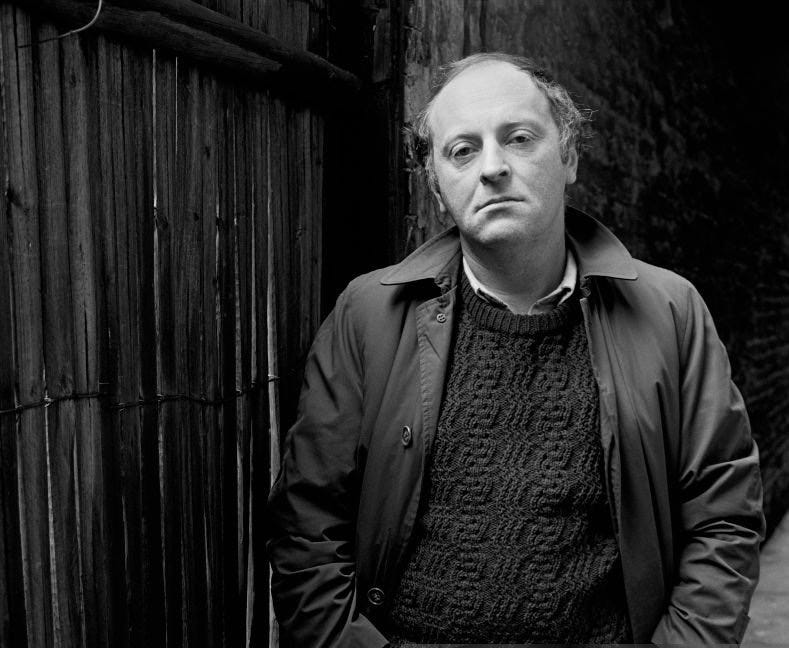
By the time Brodsky was booted out of his Motherland, he had made quite a name for himself among several renowned poets here in the United States. In May 1972, authorities invaded his apartment, seized his papers, took him to the airport, and put him on a plane for Vienna, where he was met by the American poet W.H. Auden, who’d arranged for Brodsky’s transit to the United States. After a year at the University of Michigan as poet-in-residence, he taught at Queens College in New York City (1973-74) and then returned to the University of Michigan (1974-80).
He then moved to New York’s Greenwich Village in 1980, and in 1981 received the John D. and Catherine T. MacArthur Foundation “genius” grant. He was also a recipient of The International Center in New York Award of Excellence. In 1986, his collection of essays, Less Than One, won the National Book Critics Award for Criticism and he was given an honorary doctorate of literature from Oxford University. In 1991, the United States added to his honors, naming him poet laureate. In 1990, while teaching literature in France, Brodsky married a young student, Maria Sozzani, who has a Russian-Italian background. They had one daughter, Anna Brodsky, born in 1993.
At the time of his death on January 28, 1996, Brodsky was living in an apartment in Brooklyn Heights, New York. He was 55. Both Sozzani and their daughter, Anna, were with him when he died. He is also survived by the Russian artist Marina Basmanova, with whom Brodsky had one son, Andrei, born in 1967. Brodsky and Basmanova were never formally married despite several marriage proposals from Brodsky. The cause of his death was believed to be a heart attack. Brodsky had had open-heart surgery in 1979 and later had two bypass operations, was a chain smoker, and was reported to have been in frail health for many years. He was on the faculty at Mount Holyoke College in Massachusetts, where for 15 years he had been the Andrew Mellon Professor of Literature. He had been scheduled to return there the day after he died to begin the spring semester.
After his exile, Brodsky had traveled widely, including 17 times to Venice, which reminded him of his former home in Leningrad, another city of canals. I have visited both cities and I can speak to his attraction to their watery, melancholy beauty; I’ve felt it myself. As a result of his time in Venice, Brodsky published, in 1992, a slim book titled Watermark. He called Venice “the greatest masterpiece our species ever produced.” His wife, Sozzani, arranged for him to be buried on the cemetery island of San Michele just north of Venice, where Brodsky had often wandered among the tombs of other exiled Russians, notably the composer Igor Stravinsky and the ballet impresario Serge Diaghilev.
The communal apartment in Leningrad that had once been part of a palatial enfilade but then turned into an apartment that housed four families sharing one kitchen, one bathroom, and one toilet—and where Brodsky had spent his restless youth—was transformed, in 2021, into a private museum. The museum includes many of Brodsky’s papers, photographs, and belongings, including the desk that Brodsky had used in his Brooklyn Heights apartment, which had to be taken apart, packed, shipped, and reassembled. The establishment of the Joseph Brodsky Museum to honor the writer’s life and work had been in the works for many years. Ironically, it had been held up by an elderly last resident who had lived in her room her entire life and was adamant in refusing to leave, reportedly saying: “You cannot uproot an old tree!”
Among the closing lines of his “In a Room and a Half” essay, Brodsky reflects on his youth and the life of his parents:
“I am them, of course; I am now our family. Yet since nobody knows the future, I doubt that 40 years ago, on some September night of 1939, it crossed their mind that they were conceiving their way out. At best, I suppose, they thought of having a child, of starting a family. Fairly young, and born free on top of that, they did not realize that in the country of their birth it is now the state which decides what kind of family one is to have, and whether one is to have a family at all. When they realized that, it was already too late for everything except hope. Which is what they did until they died: they hoped. Family-minded people, they couldn’t do otherwise: they hoped, planned, tried.”
Selected Bibliography
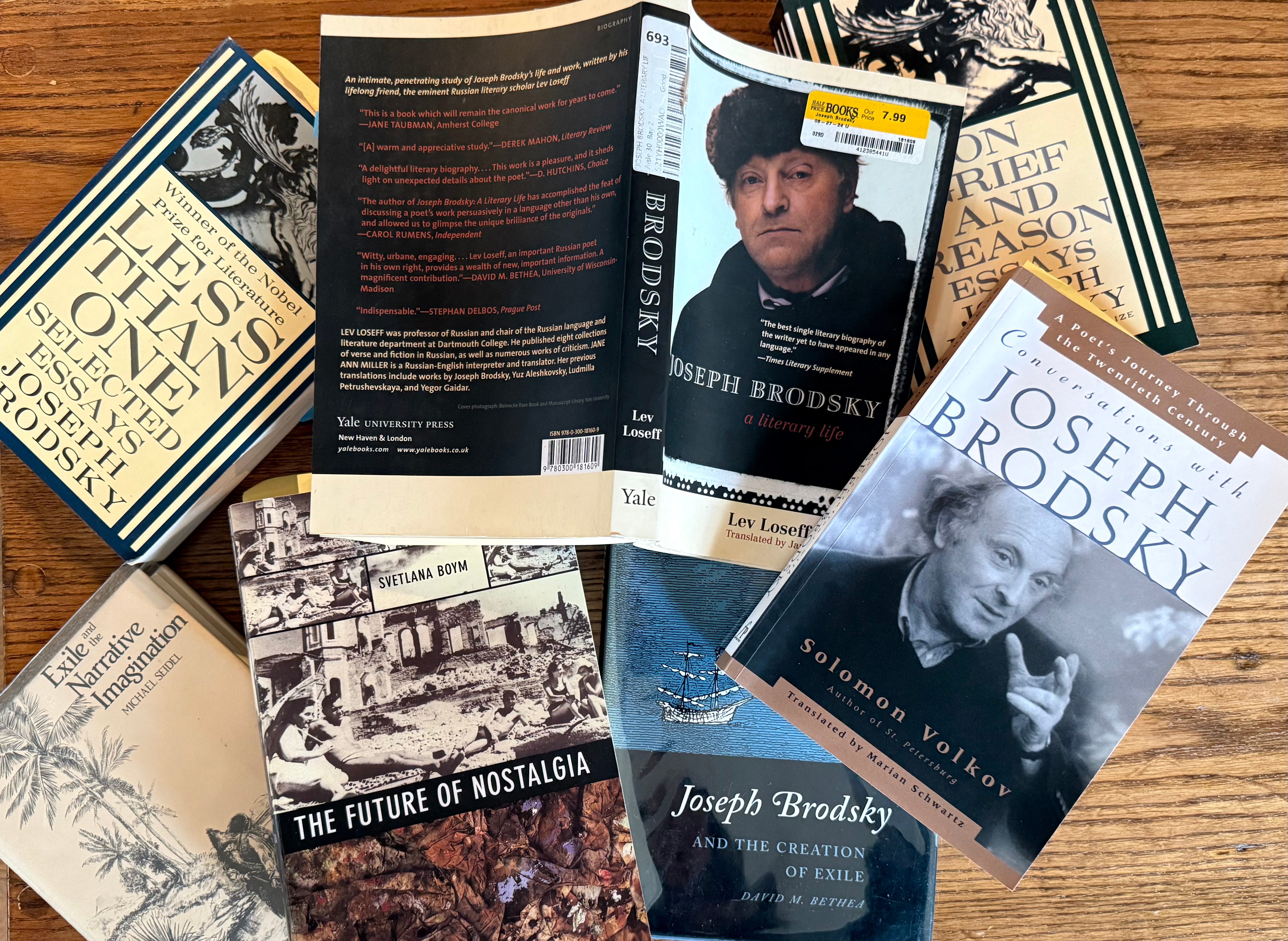
Bethea, David M. Joseph Brodsky and the Creation of Exile. Princeton, New Jersey. Princeton University Press, 1994.
Boym, Svetlana. The Future of Nostalgia. New York, New York. Basic Books, 2001.
Brodsky, Joseph. Grief and Reason: Essays. New York, New York. Farrar, Straus, and Giroux, 1995.
Brodsky, Joseph. Less Than One: Selected Essays. New York, New York. Farrar, Straus and Giroux, 1986.
Loseff, Lev. Joseph Brodsky: A Literary Life. Translated from the Russian by Jane Ann Miller. New Haven, Connecticut. Yale University Press, 2011.
Volkov, Solomon. Conversations with Joseph Brodsky. Translated from the Russian by Marian Schwartz. New York, New York. The Free Press, 1998.
Don’t want to pay for a subscription? You can leave a one-time tip for as little as $5. Every little bit helps me pay the bills.
I’ve been posting this column on the last Thursday of each month. Because the last Thursday in November was Thanksgiving, I decided to post this today, Sunday. I’m thinking about posting the column on the last Sunday from now on. Or on Saturday. What do you think? Please let me know in the poll below:
I would love to hear from you. Please comment below. Or email me at jimkullander@gmail.com
Another excellent meditation and deep exploration of the effect of the events of 2020. It is too easy to toss that experience into the dustbin of forgetfulness. I like that you are really working through it, via literature, and a very close look at your own response to what happened. As you say, paraphrased, healing has its own timetable. Again, I really like the clarity of this piece, the emerging strength of the writer, very able to convey who he is, what he thinks and feels. That whole part too of going grocery shopping etc. and "pretending" to be part of that world that is lost forever. Yes. That says so much of what it feels like for us.
I wrote the following words today at another blog site I visit on occasion. The topic of discussion was The Old State Saloon in Eagle, Idaho that's gifting a whole month of free beer to whoever helps ICE identify and deport an illegal alien, or more. Local blue-haired nose-ringed liberals are frothing mad, demonstrating, getting arrested themselves for promising violence, etc. The discussion was mostly a focus of where one might live anymore to be near "your kind" whether it be liberal-blue or conservative-red. The fake pandemic erased those distinctions for me. I wrote this...
"I’m on acreage out in Santa Fe County about 10 miles from one of the most liberal enclaves that exist. Not as bad as Portland or Seattle but only because the population here is so small. I’ve got really beautiful views and can drive into wilderness in just a couple of minutes. The snowcapped mountains are visible from my bedroom window. Physical nature in northern New Mexico is amazing… it’s only people who suck.
I’ve got neighbors living on 3 or 4 or 5 acre spreads and I invited about 35 households to my place for an HOA meeting in 2021. The 2020 meeting got called off because of the “pandemic” which I place in parenthesis because I didn’t believe it for even one minute. The emailed message went out, “Who would like to offer their house for the meeting?” I replied to everyone, “C’mon over to my place! And now that everybody’s been vaxxed you don’t have to wear a face mask.” The hatred and curses that spewed forth from my computer screen blew back my hair. However, I was laughing as my neighbors called me “racist” even though we’re all white here. I was called “science denier” and “anti-vaxxer” and “misogynist.” I was called everything but “child molester.”
So I wrote back… “Hey everybody, wait a second! Don’t you all love going to the restaurant? Even though you know there’s a DEADLY airborne virus gonna kill you, you go to the restaurant and stand there with your mask on in the DEATH ZONE while they fetch your menus. Then, once you’re seated you take off the face mask because everybody knows there’s no virus down there. That’s the science! So once you’re at my house and everybody is seated will the face masks come off?” Even MORE hatred and vitriol came forth. These people, my neighbors, wanted to kill me. The meeting was switched to a zoom call and I didn’t participate.
There’s a difference between red and blue, liberal and conservative. But when everyone obeys government blindly, stupidly, then they’ve morphed into an undistinguishable blob. To abandon all your rights and make obedience the highest virtue? Now you’re all the same. You ALL suck. It’s un-American to obey and trust government. So I wave if someone waves at me but I don’t hang out with anyone. As for this post here? I live in my own private Idaho."