
The Psychoanalysis of Fire
A Meditation on a Book by Gaston Bachelard

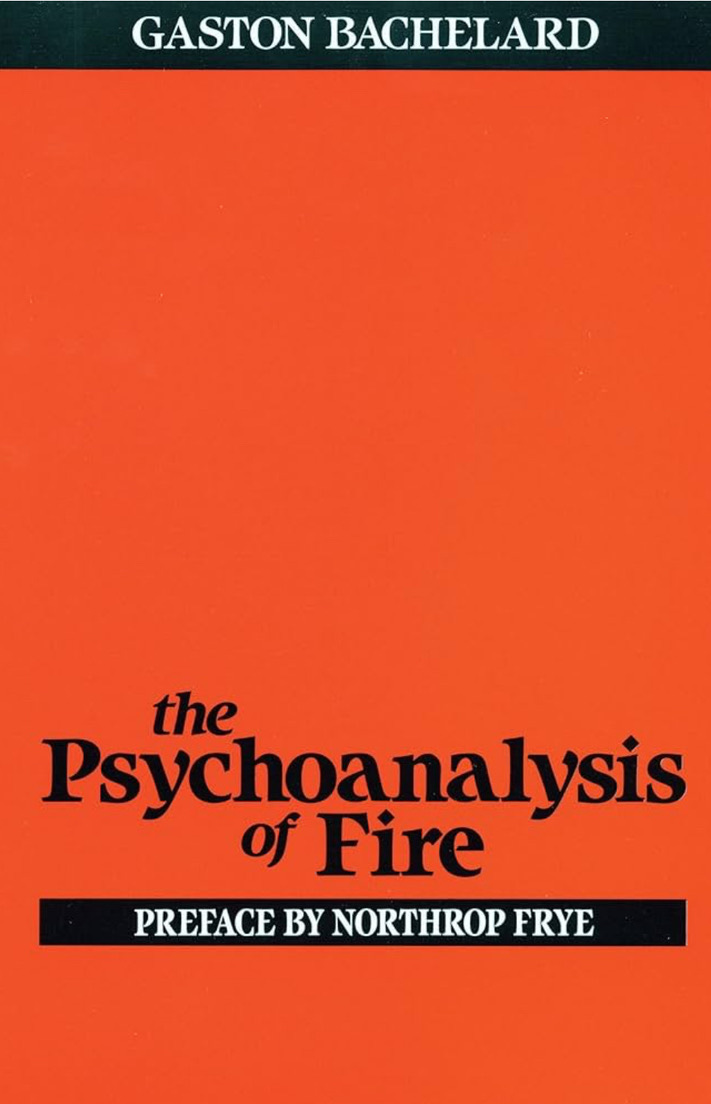
“I think I would rather fail to teach a good philosophy lesson than fail to light my morning fire.”—Gaston Bachelard, The Psychoanalysis of Fire
1.
We set many fires that summer, my friend and I. We never let them get too big—or tried not to. We’d found a field on a hill not far from our homes yet out of sight of both of them. Being only 10 years old, we imagined we could get away with anything without our parents ever finding out as long as we couldn’t be seen doing it.
I had stolen a book of matches from my parents’ cigarette drawer in the kitchen. From time to time, my friend and I would go to that field and eagerly gather dead leaves and fistfuls of the tall, dry grass and bundle it together on the ground. One of us would strike a match to get a fire going. Then we’d watch it grow, feeding it more leaves and grass, daring each other to hold off before one of us would start to stomp it out. It was a kind of game of chicken. And it was great fun.
Each time we did this, we’d let the fire get a little bit bigger to keep apace of our growing confidence—or foolhardiness; they often go hand in hand. Icarus has a lesson for us here, but I hadn’t yet learned about his disastrous story. One day the fire grew so big, so fast—I don’t recall who jumped first—that we could not stomp it out. Suddenly, it seemed, there were flames spreading everywhere in an expanding ring of fire that surrounded us and exceeded our juvenile antics to put it out.
We tripped over ourselves running down the grassy hill in our charred sneakers and then along the paved road to my house, the closest of the two, where I breathlessly told my mother in the kitchen that “someone” had started a fire in that field. This may not have been the first lie I ever told but it is the first one I remember telling. I don’t recall the chain of events that unfolded immediately after. I imagine my mother called the town’s fire department, which must have rushed to the scene to dowse the flames. What I do remember is what happened later that day.
The town’s fire chief came to our house. A big, tall man in a dark blue uniform and hat, he was terrifying to me. We stood in the front hall just inside the door and whatever he said filled me with dread but less than the fear I felt being a Lilliputian in his gigantic shadow. I’m sure I confessed and I’m sure I got a lecture regarding playing with fire. And that was the end of that. I don’t recall my mother or my father punishing me. It wasn’t necessary. I’d learned my lesson.
But that is not the end of this story. A couple of years later, a new house was built on that very field my friend and I had used to set our fires. My parents befriended the couple who’d moved in and one evening we all went to their house for dinner. My mom and dad must have told the newcomers about the fire I’d set on the property, the one that had gotten out of our control. The amazing thing to me was that this couple had a very cute red-headed daughter my age, with whom I instantly fell in love with...head over heels.
Merely was her name. I never told Merely about the fires my friend and I had set on the land upon which her home now stood. I must have been too embarrassed. Nor did I tell her how much I cherished her. Probably for the same reason. Looking back, I like to think that the fires my friend and I had set, especially the final one that had gotten out of hand, had mysteriously but fatefully conjured up this fire-haired young beauty for me to adore, my first true love, the first real fire of my heart. From that inextinguishable fire came a love I could not deny. It was the first of many similar romances to come, often accompanied or occasioned by fire, an initiation into the phenomenon sages say encompasses the full flowering of what it means to be human: Falling in love.
2.
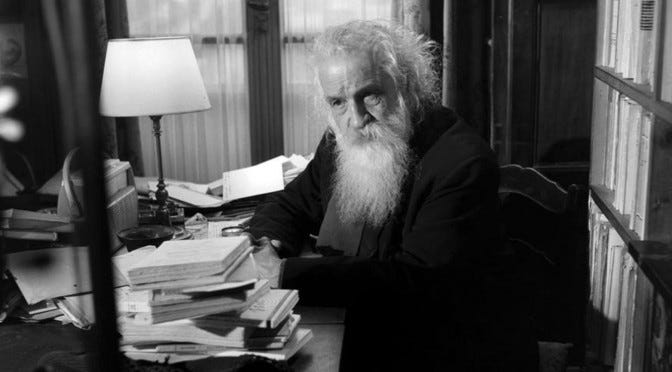
Gaston Louis Pierre Bachelard (June 27, 1884—October 16, 1962) was a French philosopher and theoretician of modern science. His book, The Psychoanalysis of Fire, is a slim (112 pages) volume exploring the scientific, psychological, and philosophical implications of fire, linking it to human thought and culture.
Originally published in France in 1938 under the title La Psychanalyse du Feu, the book was later published in English in 1964—one of just a handful of Bachelard’s 30 or so books that were ever translated into English and found an audience, albeit a small audience, here in America.
This book is the first in a series Bachelard wrote on the four classical elements (followed by studies on water, air, and earth). In this book on fire he explores, through a psychoanalytic lens, both the individual and collective human reveries, as he calls that somewhat dreamlike state, that overcome us when we gaze into an open fire.
I cannot recall when I first read the book but I return to it from time to time, just as I return to fire itself. I re-read it most recently for this essay, sitting by the fire in my woodburning stove. I imagine this is something the elder Bachelard himself would have done, sitting by the fireplace in his home, reading or perhaps in the still of those moments, recollecting the fires of his youth. He writes:
“When I was sick my father would light a fire in my room. He would take great care in arranging the logs over the kindling chips and in slipping a handful of shavings between the andirons. To fail to light the fire would have been incredibly stupid. I could not imagine my father having any equal in the performance of this function, which he would never allow anyone else to carry out. Indeed, I do not think I lit a fire myself before I was eighteen years old. It was only when I lived alone that I became master of my own hearth. But I still take special pride in the art of kindling that I learned from my father.”
This passage reminded me of a Robert Hayden poem I read years ago and has stuck with me since, titled “Those Winter Sundays.” In the poem, Hayden writes of the unflagging devotion of his father in rising each morning at dawn to get a fire going in the house—on “Sundays too”—and how, as a youth, the young Hayden was unaware of his father’s enduring and loving sacrifice, ending the poem thus:
What did I know, what did I know
Of love’s austere and lonely offices?
While the heat generated by a fire is surely a great comfort, fire has an additional role in our lives, Bachelard believes. And that is to offer us an object of reverie, as I mentioned above. A reverie is different from a dream, Bachelard insists, “by the very fact that it is always more or less centered upon one object.” He continues:
“The dream proceeds on its way in linear fashion, forgetting its original path as it hastens along. The reverie works in a star pattern. It returns to its center to shoot out new beams. And, as it happens, the reverie in front of the fire, the gentle reverie that is conscious of its well-being, is the most naturally centered reverie….
“The fire confined to the fireplace was no doubt for man the first object of reverie, the symbol of repose, the invitation to repose. One can hardly conceive of a philosophy of repose that would not include a reverie before a flaming log fire. Thus, in our opinion, to be deprived of a reverie before a burning fire is to lose the first use and the truly human use of fire.”
In other words, it was not just the heat of a fire that first drew our ancestors to them; and it was not only for the cooking of food for which fire was first used. No, it was the reverie of fire that first attracted our ancestors. Bachelard writes:
“To be sure, a fire warms us and gives us comfort. But one only becomes fully aware of this comforting sensation after quite a long period of contemplation of the flames; one only receives comfort from the fire when one leans his elbows on his knees and holds his head in his hands. This attitude comes from the distant past. The child by the fire assumes it naturally.”
3.
Throughout my life I have been drawn to fire. Perhaps glowing somewhere in my depths, the memory of that turn of events with those small field fires that I imagined had summoned the flame-haired Merely seemingly out of thin air began my lifelong love of fire. Not wild field fires but camp fires and fires in fireplaces and woodburning stoves—more contained and, let’s say, domesticated forms of fire but no less enchanting to me. And over the years I’ve had plenty of opportunities to indulge in this object of affection—or obsession. And to appreciate fire’s everlasting companionship, sometimes during the most difficult episodes of my life.
All of the homes my family lived in when I was growing up in Connecticut—each home being larger than the one before to accommodate our growing family—had a fireplace in the living room. Every winter, I was allowed to build and start the fires that warmed us most winter nights. I tended them, fetching logs from the screened porch to feed these fires when needed, stoking the coals with an iron poker to keep the fire burning.
Mostly, I remember how I’d gaze into the fire, feel its warmth on my face and clothes while my three siblings were at the other end of the house watching television, which Marshall McLuhan in his renowned 1964 book Understanding Media: The Extensions of Man, likened to a kind of modern campfire, to which I’ve never warmed up and still haven’t. I found early in my life that fire speaks to me in a language I learned without a single lesson, as if I had been born with this fluency. Yet, fire seemed like a friend I could just sit with and not have to talk. Which is something I did not have with people then. I never felt lonely being near a fire. I feel the same way today.
The years passed and we moved away from the neighborhood where I’d set that field on fire. I don’t recall ever again thinking about Merely whenever I built a fire or found myself enveloped by its warming embrace. But maybe the memory of her still flickering in what was then my young and impressionable soul has lived on and kept me coming back to any fire anywhere I could. To me, wherever there is fire, there is home. Fire is my moveable feast, as it was for ancient nomadic tribes who assigned a trustworthy individual the responsibility of carrying embers over the distances of time and space in order to build a fire wherever they temporarily settled. If I had lived back in those times, that firekeeper would have been me. I would have insisted on it and I would have never failed my duty, just as I had taken it on in my family’s homes when I was growing up. And which I have continued to do throughout my life whenever and wherever I had the opportunity.
In my late 20s, I went on a weeklong canoe trip with a friend in northern Minnesota’s vast Voyageur’s National Park. After two long days on the road from our small apartment in suburban New Jersey, we’d paddled deep into the wilderness with no guides but a map and a compass. We found a remote spot to set up camp for several days. Each night, we made a fire on the shores of that small peninsula of Rainy Lake, partly to keep the mosquitos at bay but mostly because camping without a fire was entirely pointless to me. The beauty of that spot was that there weren’t any other people around or any light in sight except for the many stars above us and the singular fire at our side.
One night by the fire, I read Aldo Leopold’s 1966 book, A Sand County Almanac. I was so engrossed in the book that I kept the fire going for hours so I could keep reading by the fire’s chiaroscuro light. At one point I looked up at the sky, long after my friend had crawled into our tent and fallen asleep, and saw it was no longer dark. I first thought it was the northern lights. But presently I heard birdsong. I realized then that I’d read through the night. The sun was coming up. And I still wasn’t tired.
Those nights by the fire were filled with the wonder of seeking new knowledge about myself and the world around me. And my search for the love of life itself, which for me, I was beginning to discover, was to be found in the wilds of nature and in reading. Those nights left a lasting impression on me. I still have that copy of A Sand County Almanac. Its pages have now yellowed and become brittle, yet still bear the marks of sentences that I had underlined some 40 years ago. And I still savor the times when I am reading by an open log fire.
Over the years since, whenever I went on extended autumnal overnight hikes in the remote forests of the Adirondacks with my then wife, we’d always set up camp with plenty of daylight left to gather enough twigs and downed tree limbs so I could keep a fire going well into the night, even after—like my friend in the wilds of northern Minnesota—my wife had climbed into our tent and fallen asleep.
When we shopped for our first house, one of my requirements was that it had to have a fireplace. After we separated, I bought a small, old house of my own. It had no source of fire but I was quick to remedy that deficiency. The first improvement I made after the ink on the closing papers was barely dry and the keys were handed over to me, was to have a woodburning stove installed.
I’m still in this house going on 27 years later and my love for fire has never died out. From autumn to spring I keep a fire going in my woodstove. I could always turn up the thermostat. Maybe I’m saving a little money by burning wood instead of fuel oil. But for me that’s not the point. The point is having that comforting presence of fire at my side—keeping me warm, yes, but also evoking memories, stilling the present moment, and inspiring dreams of the future—all of it encouraged by the consistency of an abiding fire that needs my care and attention as much as I need all that it gives me in return.
When my father retired, he and my mother moved South to a new, large housing development on the outskirts of Savannah, Georgia. Many of the residents of these new homes were, like my parents, retirees from the North. Many of these houses, like the house my parents bought, had fireplaces. And this despite the fact that the outside temperatures of Savannah rarely needed any fire to ward off the chill even in the depths of winter. I suspected the developers of these houses put fireplaces in them to give us northerners a feeling of home we’d long been accustomed to and had left behind.
And they were right. Every Christmas we celebrated there—I and my now grown siblings driving or flying or taking Amtrak from our own far-flung residences—we lit a fire in the living room fireplace just as we had always done back North. It was not for the utility of fire’s heat that we got a fire going. It was for the fire’s festive function. I fed the fire, picking out logs from the small stash on the deck outside the sliding glass door just as my father—sitting in a chair and playing Santa as he did every Christmas—was picking out wrapped gifts from under the Christmas tree to hand to us.
Sometimes the fire made the house so warm that the central air conditioning kicked on. But even then, we did not tamp down the fire. We didn’t want to tamp down our celebratory mood and the memories of those joyous Christmas gatherings of years past when we were all so much younger and still living together under one roof and there was snow outside.
More recently, I used to gaze into the fire at my girlfriend’s beautifully converted barn where she lived before she moved to another home. I remember it had a brick Rumford fireplace that we sat in front of whenever I was there in the colder months. One time after she’d gone to bed, I remained by the fire. I never liked having a fire screen between me and a fire; it not only compromises the ambience but it also reduces the amount of heat you feel from it. At some point, I grew sleepy and lay down on the rug directly in front of the fire and presently fell asleep.
Late into the evening, my girlfriend came to check on me and found me within inches of the fire’s low flames and glowing embers. She abruptly woke me up, fearing for my safety. Me, I was not worried in the least. Perhaps imbued with a touch of the hubris of Icarus, I felt confident that fire would never harm me. In the many years that preceded this incident, I like to think that I’d developed sort of mutual agreement with fire: If I took care of it, it would take care of me.
It is impossible to pinpoint the exact moment when—or how—prehistoric man discovered fire. Bachelard writes: “Even if two pieces of dry wood had fallen for the first time into the hands of the savage, what previous experience would indicate to him that they could be ignited by a long-continued rubbing action?” What is known is that fire in ancient times was not easy to make.
“They had to hold onto it once they had it,” writes Stephen J. Pyne in his 2002 book, Fire: A Brief History. He continues:
“If they lost it, they could get more only by begging, borrowing, or stealing from others. Yet it was rare for groups to give fire away. It was too precious. They share only within a clan, from a common source, and shared with outsiders only during core ceremonies like marriage or treaty-signings, where the comingling of fires symbolized the merging of their interests. To lose fire could be disastrous, the very symbol of catastrophe….
“So they strove to preserve fire. Slow matches, banked coals, embers insulated with banana leaves or birch bark, perpetually maintained communal hearths—all kept fire constantly alive. With suitable kindling and coaxing, new fires could be ignited from this source. The effort to preserve the hearth fire or the sacred fire of the larger community had thus an immensely practical purpose, eventually coded in elaborate ceremony and symbolism. Many peoples, moreover, carried their glowing embers with them when they traveled. It was first believed that Australian Aborigines, Tasmanians, and Andaman Islanders, for example, did not know how to start fire because for long decades they were never seen to kindle one. Instead, they carried their firesticks with them.”
4.
From that first field fire and its accompanying initiatory experience of falling in love, other fires over the years have accompanied me through other initiatory experiences along the path of becoming a fully developed human—celebration, commitment, heartbreak, jealousy, mourning. The most recent experience through which fire kept me company and comforted me was betrayal. By that I mean the betrayal of nearly every friend I have (or had) on account of their complicity with the greatest tragedy to ever befall the human race: The COVID-19 psyop.
One by one, and then suddenly, nearly all of them threw themselves into the mosh pit of the pandemonium, rendering me a pariah simply because I had chosen not to leap into the fray with them and be injected with poison. They banned me from weddings, dinners, get-togethers, and even my job. I was still lighting a fire each morning in my woodstove in March 2020 when the world was suddenly locked down and overcome with complete insanity. And as I gazed into the fire here in my house, the sense of betrayal I felt settled into a profound sense of disappointment. All these astute people I thought I knew so well turned out to be not as astute as I had thought. And then the disappointment settled into another one of those initiatory phases of human growth: Despair.

Many years ago, one of these former friends hosted an annual New Year’s Eve party at her home in the Catskills. The house had a big, rounded river stone fireplace. Over the course of the evening, each of us picked from a big wooden bowl a pine cone covered with glitter. At the turn of the New Year, we were invited to psychically invest into the pine cone any psychological or emotional and spiritual hinderances that we wanted to burn away so that we might be able move on in our lives. Then when the moment felt right, each of us tossed the pine cone holding our burdens into the flames and watched all those negative energies that no longer served our growth go up in smoke in a kind of funeral pyre. It was nice to think so, anyway.
Now, as I settle into a New Year, I’m gazing into the fires in my woodstove and trying let go of that debilitating trinity of betrayal, disappointment, and despair that has dogged me the past six years. Maybe I need to try that pine cone trick again because nothing else I do to let go of all of that seems to last very long.
I continue to write about the COVID-19 psyop because the damage done to humanity around the world is both unprecedented and lasting—our physical and mental health, our economy, our ties to friends and family, our intimate relationships, our educational systems, the way we work, our aspirations, our social fabric, along with an unholy host of other assorted instances of enormous carnage and individual indignities. Generations of people, from the very young to the very old—and even the unborn of some parents who took the jabs—have been quietly and permanently ruined, if not terminated.
Not to mention the emotional wellbeing of those who lost people they love—husbands, wives, siblings, parents, grandparents, children, friends—on account of the jabs, and yet remain at a total loss to understand why because the mainstream narrative does not want us to know the truth. But I believe that someday the truth will out in a big way, perhaps in dribs and drabs at first—at the same rate of those who took the COVID-19 bait—simply because it cries out of the depths of so many of us to be revealed.
I cannot silence myself, not my anguish over what’s happened nor my longing for vindication. The victims of the jabs, many of whom I knew, need to be acknowledged and the cause of their deaths revealed, while the numbers of those who die because of the jabs continue to pile up much like those body bags we were led to believe contained the victims of the so-called deadly virus. And the perpetrators need to be charged and tried for their heinous crimes. So, the fight isn’t over; it’s just beginning. And it’s going to be a long one.
5.
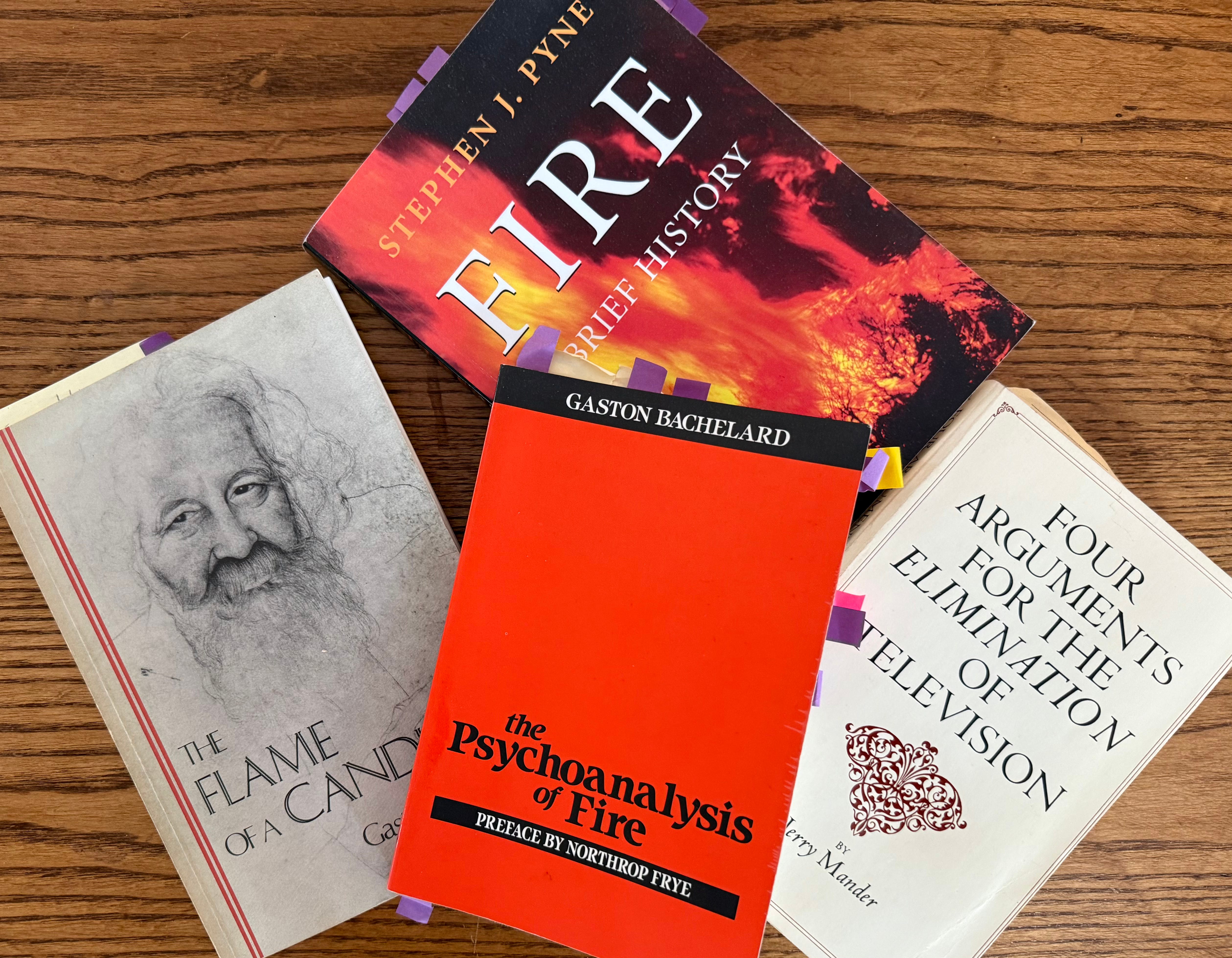
Bachelard makes a case for the idea that scientific thinking had entered a new phase following Albert Einstein’s work on relativity, drifting slowly but surely from objects perceived by the senses into a realm whereby the scientific mind began comprehending the world in terms of mathematical measurements. Bachelard argues that the human attraction to fire is deeply rooted in primal, subjective experiences and those dream-like reveries, which produce seductive but misleading intuitions. To his mind, these intuitions hinder the development of rigorous science. He based this belief on his own experience, for “what initially drew his interest away from scientific inquiry, was fire imagery,” writes Joanne H. Stroud in the foreword of another Bachelard book on the topic of fire, The Flame of a Candle.
This scientific modeling of reality based on mathematical measurements as opposed to sense perceptions seems to have also altered the way we see the world. More than ever before many things we see today and are convinced are real are not real. What we’re seeing on our screens is composed of nothing but pixels—picture elements—the smallest units of a digital image or display. There is no substance behind the image, nothing real. What we see can be a total illusion.
In the same way that fire produces reveries, images of violence produce fear and division and hostility, and these images are coming at us these days like debris hurled through the air of a sustained gale force wind. The threat of the unreal—for that’s often what we’re dealing with nowadays—is becoming ever more problematic with the incursion of AI into our daily lives. It’s become ever more problematic because if we cannot agree on what’s real we cannot begin to agree on what’s not real. And it is becoming increasingly clear that agreeing on what is real and not real is how our national cohesion and civility rises or falls.
The greatest of all these illusions in human history was the COVID-19 psyop fomented by electronic images and the “data” of supposed “case numbers” and deaths displayed on the screens of our televisions and devices around the clock. Many were convinced of the media’s version of reality even though it didn’t exist in actual reality. It was nothing more than a livestreamed movie with such poor production values that anyone with just an ounce of discernment could see it for what it was: A complete lie.
Yet the great majority of the world’s population believed that what they were seeing was true. Much the same manipulation continues to generate fear and hostility among us, only now it’s not about the jabbed against the unjabbed, but insanity against sanity. By any other name, the overall objective of the predators pulling the strings is division and fragmentation—to split us in two again and again and again in order to better conquer and control us. We’re like prisoners in a concrete cellblock being shown a film made by the prison guards to get us to do what they want us to do.

Our growing, detrimental disconnection from the natural world has left many of us wandering in a kind of netherworld that is not grounded in the realities—and the wonders—of sense perceptions. For the less we live in the natural world the more we live in our head. And the more we live in our head the less we’re informed by the objective realities of the world around us. This leaves us open to not only our own sometimes deranged, imaginations but also to what others want us to imagine so that, in the case of the ruinous COVID-19 caper, for example, the predators fomenting the fear might better manipulate us, gaslighting those of us who saw through the lies in an attempt to subdue us into submission to their diktats du jour.
Which brings us back to McLuhan’s idea of the television becoming the new campfire. Thing is, this electronic campfire is not real. “He said that just as humans used to have their family or tribe gather around a fire to share the news of the day and to pass down the stories of the historical and religious beliefs of the tribe, that, now, that has been replaced by the electronic fire of the television,” a well-read friend emailed me after I’d sent him a draft of this essay. “We gather around the cold light of the television screen and the news of the day and the stories of the tribe are being told through the images on the television.”
Additionally, my friend noted how Jerry Mander, in his 1978 book Four Arguments for the Elimination of Television, also tells us that the images we see on the television screen are an illusion. “What’s there are colored pixels,” my friend wrote. He continued:
“The images themselves are assembled inside our brains and beyond our conscious minds. That is, if someone tells us a story around a campfire, the storyteller is transmitting images to us (we see the story) but those images are being filtered by our conscious minds. The images we receive from pixel screens are assembled directly in our brains and on the other side of that filter of consciousness. They are deposited directly into our unconsciousness. Perhaps that’s why it seems that people who believe what they see from the mass media, and watch a lot of that media, seem hypnotized and unable to absorb information that runs counter to their programmed unconscious even if that information is true and real. Cognitive dissonance occurs.”
Mander himself writing in his Four Arguments for the Elimination of Television opens a chapter titled “How Television Dims the Mind” with this line: “When you are watching television and believe you are looking at pictures, you are actually looking at the phosphorescent glow of three hundred thousand tiny dots. There is no picture there.” He continues:
“What you perceive as a picture is actually an image that never exists in any given moment but rather is constructed over time. Your perception of it as an image depends upon your brain’s ability to gather in all the lit dots, collect the image they make on your retina in sequence, and form a picture. The picture itself, however, never existed. Unlike ordinary life, in which whatever you see actually exists outside you before you let it in through your eyes, a television image gains its existence only once you’ve put it together inside your head.”
Can we take the experience of sitting quietly in front of a real fire, of grounding ourselves in its ageless reality, and then look around with an enhanced ability to discern fact from fiction in the changing world around us? Does a domesticated fire have such a purifying effect on the mind that it can guide us toward truth? Can gazing into a flame draw out the toxins of the world that have infected us and burn them up—with or without a pine cone? And then return to us the higher human qualities of logic and reason and critical thinking, all of which seem to have been permanently disabled across immeasurable swaths of the human population by the scale and gravity of the COVID-19 psyop.
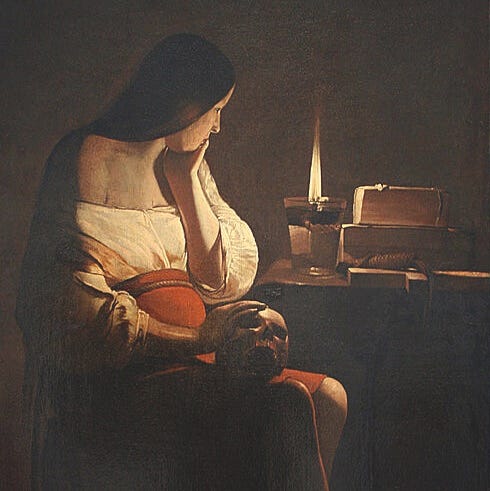
Perhaps there is no greater cure for this insidious, modern ailment and no more effective psychoanalytic treatment for many lost and confused souls than the ancient practice of sitting next to a fire burning before us, even if only before a candle flame, just as people for eons have practiced religious rites around the world, from lighting votive candles in churches to the Jewish menorah to tea lights in Hindu and Buddhist temples, all of them symbols of the sustaining love of God and our longing for union with that love.
We read of the so-called “burning bush” in the Book of Exodus, where Moses encounters a bush engulfed in flames yet is not consumed by the fire. This phenomenon occurs on Mount Sinai, where God reveals Himself to Moses, commissions him to lead the Israelites out of Egypt, and declares His name: “I AM WHO I AM.” The burning bush is a symbol of humanity’s encounter with the divine, which we can replicate in our encounters with the fires before us in our daily lives.
To be sure, we have a long history with fire. And instead of removing us from reality, as Bachelard insists, sitting before a fire can perhaps shine a light on reality, or rather on a higher reality beyond the sense perceptions and media’s illusions. Fire is a living presence that holds timeless wisdom. As a symbol of transformation, fire cleanses us of impurities and elevates the spirit. Bachelard writes in The Flame of a Candle: “We have a natural, I daresay an innate admiration for the flame. The flame intensifies the pleasure of seeing beyond what is usually seen.”
This is not science. It is transcendence.
And I think we are all hungry for this. In Goethe’s famous 1814 poem, “The Holy Longing” (translated by Robert Bly), we read:
Tell a wise person, or else keep silent,
because the mass man will mock it right away.
I praise what is truly alive,
what longs to be burned to death.
In the calm water of the love-nights,
where you were begotten, where you have begotten,
a strange feeling comes over you,
when you see the silent candle burning.
Now you are no longer caught in the obsession with darkness,
and a desire for higher love-making sweeps you upward.
Distance does not make you falter.
Now, arriving in magic, flying,
and finally, insane for the light,
you are the butterfly and you are gone.
And so long as you haven’t experienced this: to die and so to grow,
you are only a troubled guest on the dark earth.
Promotions for vacation destinations feature people mesmerized by an open fire—a group of friends or family members or strangers gathered around communal fire pit, a loving couple in front of a cozy cabin fireplace, a loner gazing into a lone fire. If these occasional moments are the only experience of real fire for many of us then so be it. It’s better than nothing at all because fires like these are inimitable food for the starving soul and a dislocated populace seeking communities of connection. Fires like these repair cultural and individual fragmentation and isolation. Around such fires there emerges a sense of homecoming not only with others but also within each of us. Exiles gather—exiled parts of ourselves, too—seeking cohesion and solace and harmony from this ageless source that has long brought people and their fragmented selves together, while also being a font of individual reverie and, last but not least, an inspiration for romance!
“In The Psychoanalysis of Fire he [Bachelard] dwells at length on the importance of having an open fire—and, what is more, a wood fire—in one’s living room; fire is not merely itself; it is an image of vitality and sexuality and therefore our eyes need to dwell on a fire when we are sitting in a state of creative musing,” writes John Weightman on Bachelard’s writings in an essay titled “Day-Dreams” in the April 30, 1964 edition of The New York Times Review of Books.
Weightman continues:
“Some hard-headed readers, comfortably ensconced in their centrally-heated apartments, will probably dismiss all this as another outburst of naïve naturism. I am inclined to do so myself, but then I reflect that after twenty-five years of living in apartments and dreaming of houses, I have at last managed the down payment on a Victorian house in Hampstead with a cellar and an attic, and that I stoke the kitchen stove each morning with unfailing relish. When it rains, I can sense the water on every tile and slate. The drains are blocked for the moment and I feel like sending for the doctor as well as the plumber. This house—however doubtful its aesthetic quality—represents, then, the solidification of a quarter of a century of day-dreams, and I am not so much living in it as dreaming it, as if it were an extension of myself. In this respect, I must admit that Bachelard has got me taped, and I imagine that his naïve naturism is true for a great many other people as well, although the details may vary a good deal more from one person to another than he supposes.”
Weightman published this in 1964, a time before the internet, before computers, before mobile phones. The only moving images one was exposed to were on television and in movie theaters. Bachelard published his The Psychoanalysis of Fire in 1938, even before television. Back in those long-gone days there was much less mass deception and the capacity for mass deception, although the Nazi regime employed radio to induce their own brand of mass hysteria and deadly vitriol. Although horrific, that dark chapter pales in comparison to the scale of deception that we witnessed during the COVID-19 psyop, and ever since in a kind of self-replicating lurid farce. One of the reasons the hoax was so successful in convincing untold billions of people that it was real was because so many people had simply and sadly attenuated their sense of reality of both the sensate world and of transcendent realms, both experienced through the reliable and undeniable sensations of the elemental world, such as fire, which then lead us to see, as Bachelard says of a candle flame, “beyond what is usually seen.”
In the past, fires were also the center around which large ceremonies were held but, as Pyne writes, “as the Enlightenment spread, few of the educated elite could see any purpose to the fires at all.” He continues:
“Today, when most people in developed nations live in cities, there are few ceremonies of open burning left. What once inspired awe now reeks of the quaint and disreputable. Fire rites have shrunk to votive candles and eternal flames over memorials. For intellectuals, the flame has become sheer symbolism, rooted in an archetypal subconscious. It speaks a deconstructed ecology of culture—words that come from words, rites from rites, symbols from symbols—not as something whose practical effects were known to every hunter, forager, farmer, herder, or anyone else whose contact with flame resided outside of books, cities, and TV screens.”
Short of a log fire, one could always turn to candle light for one’s solace and reverie, as I mentioned above, even though Pyne might belittle such an experience. Not so Bachelard. He writes in The Flame of a Candle, first published in 1961 in French under the title of La flamme d’une chandelle:
“The solitary flame has a character different from that of the fire in the hearth. The fire in the hearth may distract the keeper of the flame. A man who stands before a talkative fire can help the wood to burn; he places an extra log at the right moment. The man who knows how to keep warm supervises the Promethean deed. He acts out his little Promethean gestures and is so proud to be perfect keeper of the flame.
“But the candle burns alone. It has no need of a servant.”
6.
Who was Bachelard and what was his influence on those while he was among the living? For this, I’ll turn again to Weightman’s 1964 essay on Bachelard’s work in the New York Review of Books:
“He is neither a self-confessed and tortured atheist like [Jean-Paul] Sartre, nor, like [Teilhard de] Chardin, a heretic combining a belief in God with a proficiency in modern science. But, within the French context, he is almost as important as they are because he has a pseudo-religious force, without taking a stand on religion. To define him as briefly as possible—he is a philosopher, with a professional training in the sciences, who devoted most of the second phase of his career to promoting that aspect of human nature which often seems most inimical to the poetic imagination….
“A bright pupil of humble origins, he worked himself up by gradual stages until he was appointed to a chair at the Sorbonne at the age of fifty-six. Thereafter, he was a genial, bearded sage with an equal mastery of scientific and literary themes, who kept his local accent and was not afraid to be personal, and even homespun, in his writing and in his behavior. A colleague of his once assured me that, even in Paris, he retained the peasant habit of having thick vegetable soup for breakfast. As he was an early riser, he would put the soup in his pottery hot-water-bottle the night before, so that he had only to take the bottle out of his bed and empty it, before settling down to his meditations. Even if this anecdote is an invention, it is ben trovato; one can easily imagine a Bachelardian chapter on the significance of the soup kept at blood heat all night inside the stone egg, and then absorbed by the body with which it has exchanged its warmth.”
Barchlard’s other books on the four elements include Water and Dreams: An Essay on the Imagination of Matter (1940), Air and Dreams: An Essay on the Imagination of Movement (1942), and Earth and Reveries of Will (1945). But fire appears to be his first and lasting topic of interest. Bachelard died on October 16, 1962, in Paris, France, at the age of 78. He spent much of his life plumbing the depths of fiery imagery and writing about it, but about which, it has been said, he was never wholly satisfied.
Selected Bibliography
Scripture quotations, unless otherwise noted, are from the New Revised Standard Version Bible. Meeks, Wayne A., et al. eds. The HarperCollins Study Bible: New Revised Standard Version, with the Apocryphal/Deuterocanonical Books. New York, New York. HarperCollins Publishers, Inc. 1993.
Bachelard, Gaston. The Flame of a Candle. Translated from the French by Joni Caldwell. Originally published in 1961 under the title La flame d’une chandelle by Presses Universities, France. English edition published in Dallas, Texas. The Dallas Institute Publications, 1988.
Bachelard, Gaston. The Psychoanalysis of Fire. Translated from the French by Ala C.M. Ross. Originally published in French under the title La Psychanalyse du Feu by Librairie Gallimard, 1938. English edition published in Boston, Massachusetts. Beacon Press, 1964.
Pyne, Stephen J. Fire: A Brief History. Seattle, Washington. University of Washington Press, 2001.
Don’t want to pay for a subscription? You can leave a one-time donation for as little as $5. Every little bit helps me pay the bills.
Note to readers old and new: Beginning with this column, I’m putting in numbers instead of asterisks to mark each new section. I did this to help those of you who don’t read these columns in one sitting to more easily go back to where you left off. As you know by now, these essays are long, like the ones we used to read in the magazines we used to love, but which have in the past six years aligned themselves mightily yet pathetically with the predators raining hell on us from high places and their lackeys spread far and wide, driven to undermine individual human freedom and national sovereignty, the fundamental principles of Western civilization, particularly here in America—the last domino in their attempted global takeover. I take these assaults personally because that’s where the demoralization of humanity begins. It strikes at the very heart of how each of us live our everyday lives. And I hope my essays not only shed a light on the boots trampling on us but also succor our distress and encourage us to carry on. Thank you for being here.
I really liked this one a lot, Jim -- primarily because I share with you the love of an open fire. In my many childhood homes (peripatetic parents) there was never a fireplace. But I loved going fishing and hunting with my dad or just camping with friends and family, and sitting around a log fire. My favorite parties in high school were wilderness keggers that we called "woodsies," drinking beer and smoking joints around a huge bonfire. In college I painted a portrait of my favorite green candle with a tall flame, and I hung that painting on the wall of many subsequent apartments and homes until, alas, it disappeared. The primitive fire pit in my yard today has been essential to my enjoyment of living here in the Catskills, although I wish I used it more often. And the wood stove in my living room is a godsend. This winter the fire has hardly gone out at all. Stoke it up and damp it down every night, throw a little kindling and a log on the coals in the morning...round and round it goes. I may be tired of the routine by spring, but in the bitter depths of January, I love it.
Part of the meditational pleasure of fire has to be the fact that, not only is it beautiful, alive, and giving of light and warmth, but also...it is a fierce beast of destruction. Staring in a hypnotic reverie into the flames always carries that knowledge with it, underneath. Something that could easily kill you is extra lovely when it's tamed.
Destruction can be good if it's needed, forming a balance with one's timeless journey into a contemplative trance while gazing at the living flames. Both of those ideas are present in this little three and a half minute video that captures a scene from one of my novels.
https://youtu.be/ikjcPTJGLHk?si=hevEjpeAbn_W0RrI
And thanks for introducing me to Bachelard. I had never heard of him.
This article sucked me in totally. My brother and I set the woods on fire around age eight. Ran home and hopped in the bathtub together, something we'd never done before. And listened to the sirens wailing. I can still see the shock in his eyes. We didn't breathe a word of it to anyone and never got in trouble. The call went forth so fast that luckily it was extinguished without financial loss to anyone. That cured us of the fire hobby. And like you wrote, Jim, we started some small manageable ones until that big one wasn't. In teenage years camping in the forest and sitting round the fire was hypnotic. While I was reading this article the thought occurred to me, once again because I theorized it long ago, that television is the modern version of the fire. Then you quoted Marshall McLuhan saying the same thing! I never knew anyone had ever put it into words. I thought I was so clever.
Every house I've rented from age 25 onwards had a fireplace. When I built my own post & beam straw bale house age 40 I installed three wood stoves. It's 30 years later and I'm planning, finally, to build a garage/shop and there will be a wood stove there, too. And something I might have sent you in a private message regarding the evil Dr. Fauci? I'll share it here for your readers. Fauci knew all along that the immune system was capable of fending off the flu, but they waved a billion dollars under his nose and the rest is history. A new FOIA discovery.
https://tinyurl.com/4bhcyyeh